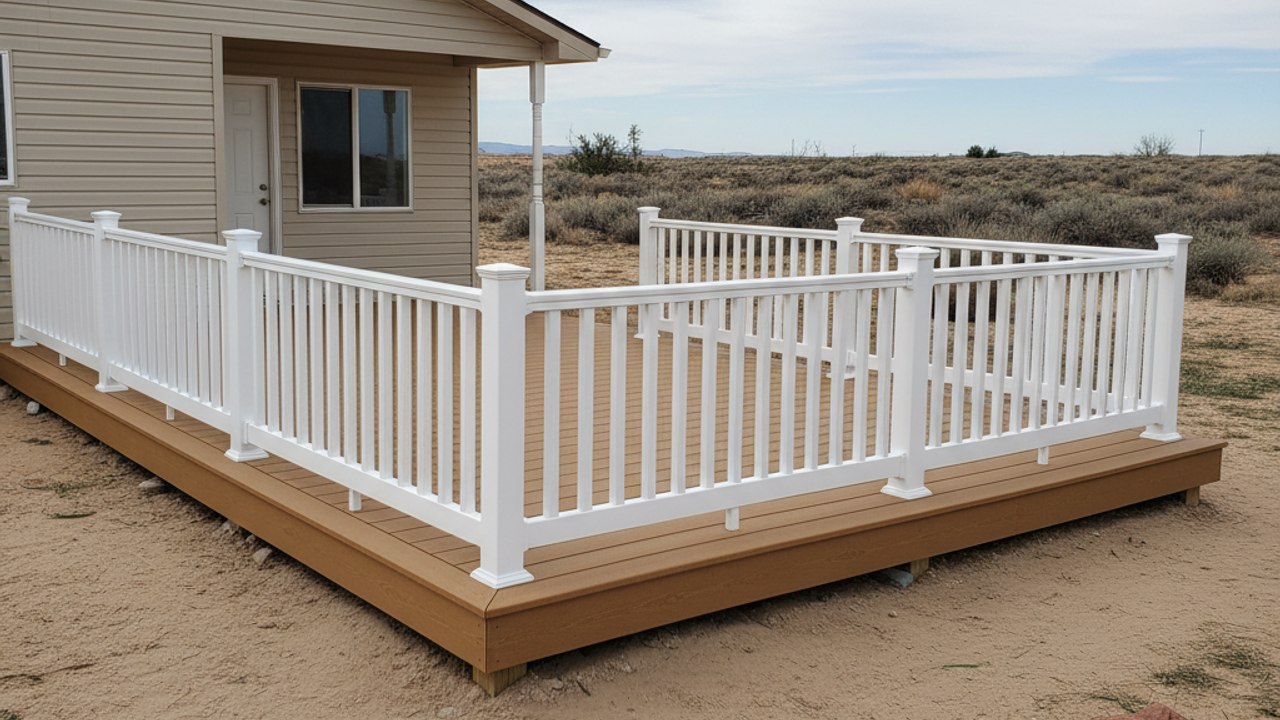
Every year somebody in Henderson or Summerlin pays a guy in cash to build a deck, and every year a few of those decks end up with footings sitting on top of caliche instead of into it. The deck looks fine for a summer. Then the ledger board pulls away from the house or a post starts rocking, and the homeowner finds out the hard way that not everyone who owns a circular saw understands what this valley's ground and sun do to a structure. This is the stuff to check before you sign anything.
Ask what they're doing about the caliche
A lot of the Las Vegas valley sits on a hardpan layer of calcium carbonate a foot or two down, sometimes shallower. It's basically cemented soil, and a regular post-hole digger won't touch it. Footings for a deck need to go down far enough to bear on solid material, usually a minimum of 12 inches below grade around here depending on the soil and the local code, and if the crew hits caliche at 8 inches they either break through it with an auger and carbide bit or a jackhammer bit, or they stop short and pour a footing that isn't deep enough. A builder who's worked this valley for a while has a story about a caliche layer that took twice as long to get through as expected. If a bidder has never heard the word, that tells you something.
Ask directly: how deep are the footings going, and what happens if you hit rock before you get there? A vague answer is a red flag. A real answer sounds like a guy describing a problem he's actually solved before.
Check the license and ask who pulls the permit
Nevada requires a contractor's license for this kind of work, and the number should be checkable through the state contractors board. Ask for it, and actually look it up. Then ask who is pulling the building permit, because in Clark County and in Las Vegas, Henderson, and North Las Vegas, an attached deck almost always needs one. Permitted work gets inspected, usually at the footing stage before it's covered up and again at framing before decking goes down. That inspection is the one thing standing between you and a deck that fails quietly over two or three years instead of being caught while it's still just rebar and concrete.
If a builder tells you permits are "not worth the hassle" or offers a lower price for skipping one, walk. Unpermitted decks show up as a problem when you sell the house, and they show up sooner than that if there's ever a structural issue and the insurance company asks questions.
If you're in an HOA, and a lot of Summerlin, Anthem, Green Valley, and Mountain's Edge are, there's usually a design review step before the permit even gets submitted. A builder who's done work in your community will know that and won't be surprised by it.
Understand what the heat does to materials
Vegas summers push deck surfaces to temperatures that would burn bare feet, sometimes past 150°F on dark composite in direct July sun. That matters for two reasons. First, composite boards expand and contract with heat more than people expect, so the spacing between boards and the fastening pattern have to account for it, or you get buckling. Second, wood decking here dries out fast. Redwood and cedar that would need staining every three years in a wetter climate often need it every year or two in this sun, because the UV and the dryness both work against the finish at the same time.
A builder who does a lot of composite work in this market should be able to tell you which brands hold up without fading badly after a couple of summers, and which ones are cheaper for a reason. A builder who only does wood should be upfront about the maintenance schedule you're signing up for, not just the upfront cost.
Ask about flashing and the ledger board
Most of the year Las Vegas is bone dry, and then monsoon season hits from roughly July through September and dumps an inch of rain in twenty minutes on ground that's been baked hard enough to shed water instead of absorbing it. Where an attached deck meets the house, the ledger board has to be flashed properly so that water running down the siding during one of those downpours doesn't get behind the board and start rotting the rim joist or the sheathing. This is boring to talk about and it's one of the most common failure points in decks nationwide, not just here. Ask what flashing they use and how it's installed. If the answer is a shrug, that's the part of the job most likely to cause a rot problem you won't see until it's expensive.
Match the builder to your neighborhood's age
Homes built during the Summerlin and Henderson boom of the late 1990s and 2000s usually already have a concrete patio slab, and the deck gets designed around or attached to that. Older neighborhoods closer to downtown or around Huntridge, built in the 1950s through 70s, sometimes have smaller lots, different setback requirements from the property line, and existing patio covers or additions that complicate where a new deck can go. A builder who's mainly worked new-build subdivisions might not think to check setbacks on an older lot. Ask if they've pulled a survey or checked the plat, especially if your deck is going near a side or rear property line.
What actually separates a good bid from a bad one
- A written contract that spells out footing depth, joist spacing, fastener type, and decking material, not just a total price.
- A timeline that includes inspection dates, not just a start and finish date.
- A materials list you can check against actual product names, not "composite decking" with no brand.
- References or photos of work at least a couple of years old, so you can see how it held up through a Vegas summer or two, not just how it looked the week it was finished.
- A price that isn't dramatically lower than the other bids you got. Footings, flashing, and permits cost what they cost. A number that's 30% under everyone else usually means one of those got skipped.
Walk away from anyone who wants full payment upfront, won't put the scope in writing, or gets cagey when you ask about permits. Those aren't style differences, they're the signs of a job that's going to cost more later.
A deck here has to survive summers that hit 110°F for weeks at a stretch, ground that fights you on every footing, and rainstorms that come all at once instead of spread through the year. Anyone who's built decks in this valley for a while has already made the mistakes that come with those conditions, on someone else's job. That's worth more than a low bid. If you want to talk through what a deck on your lot would actually take, Alpha Deck Solutions is a good place to start.